

Three Pillars of Lent
 I've been seeing a lot of emails and social media posts about Lent. Join this group. Download this app. Get a daily reflection. Do this Bible study. Read this book. Attend this online retreat. We are not at a loss for good Lenten resources. Maybe we have too much!
It's easy to plan a robust Lenten season and find after a few days that you can't manage it all. We sometimes get discouraged and give up, frustrated that we had yet another unfruitful Lent. It doesn't have to be that way.
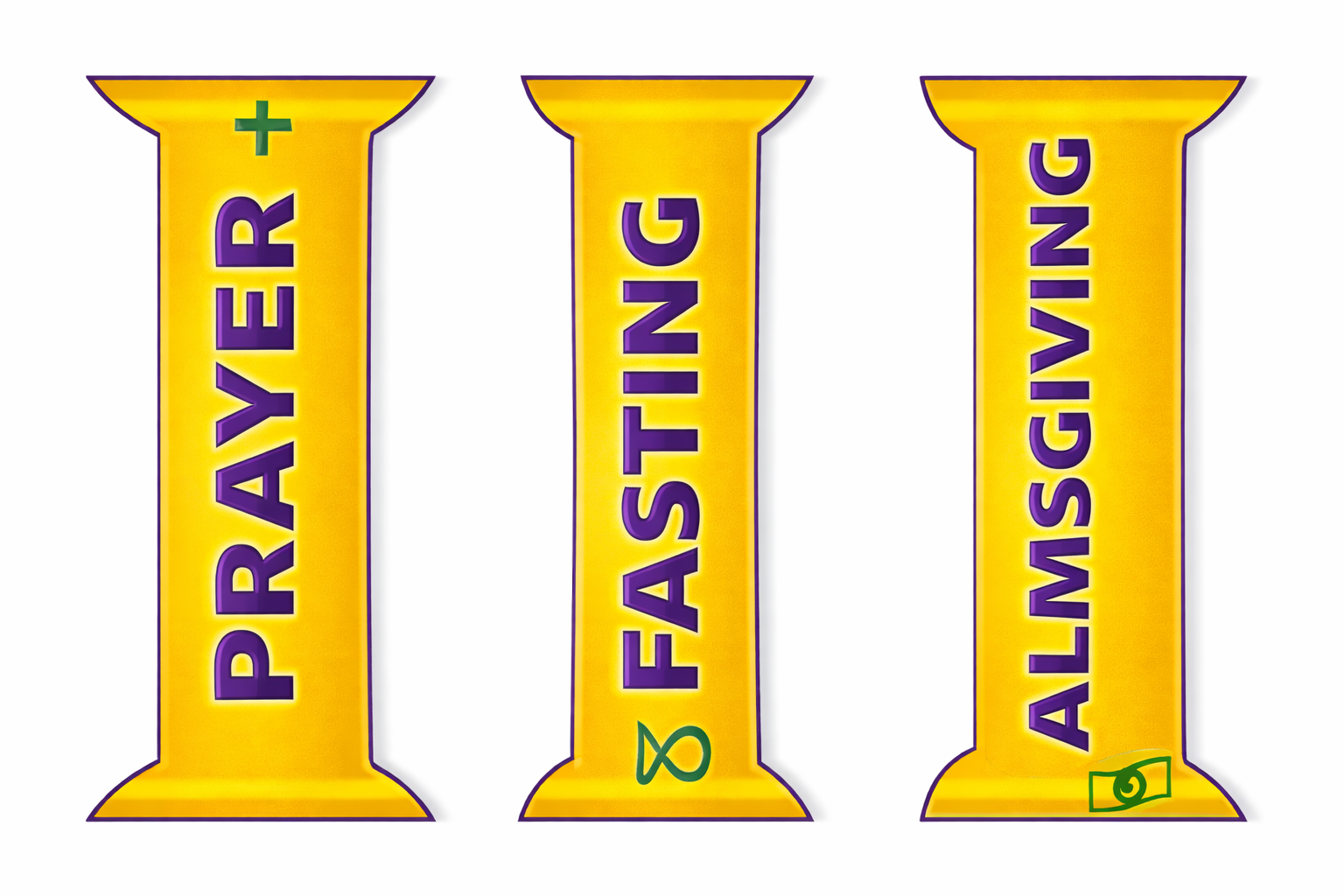
If we prayerfully consider the three pillars of Lent and how God wants us to grow through them, we can create a realistic plan for growth. The three pillars are prayer, fasting, and almsgiving. Here are some creative ways to practice these three disciplines. Perhaps they will help you discern the spiritual practices God desires for you this Lent.
Prayer: (Me and God)
Our goal in prayer is to grow closer to God, to know Him better, and to know how much He loves us. It's the relationship we have with Him. Wherever we are today, there is more. So what prayer practices will help us be open to the "more" that God wants for us now? Here are some possibilities:
-
Go to Mass, not just on Sunday, but to daily Mass if that's possible. Arrive early to prepare your heart, mind, and soul to receive the Blessed Sacrament. Stay after Mass for a bit to pray in thanksgiving.
-
Adoration: Commit to a Holy Hour in front of the Blessed Sacrament each week. Jesus asked Peter, James and John in the Garden of Gethsemane after they had fallen asleep, "Could you not watch with me one hour? Watch and pray that you may not enter into temptation; the spirit indeed is willing, but the flesh is weak."
-
Devotional Prayers: These are things like the Rosary, the Divine Mercy Chaplet, Stations of the Cross, Divine Office. You might choose one of these to pray daily or weekly.
-
Meditation: Reading and pondering passages of Scripture or a spiritual book. I read scripture every day, but don't always ponder it. I might read a phrase and think I need to go back and spend time with it, but my focus is usually on finishing the passage. This Lent, I plan to spend at least 15 minutes pondering a passage and journaling on it. It may mean that I don't get through all my reading, but that's okay. I have to reset my goals from getting through the passage to allowing God to speak to me through His word.
-
Contemplation: This means resting with God; sitting in stillness. I have a hard time with this. My mind so easily wanders. Or I talk to God, sharing my thoughts. That's good—absolutely. But sometimes we need to be still and know that He is God. We have to be still in His presence. We have to listen for the still, small voice. You might set a goal of 5 minutes a day for quiet resting with God in contemplative prayer, especially if you have never done it at all.
-
Praying without ceasing: Paul gave us this instruction in 1 Thessalonians 5:16. What does that mean? It means that we offer each part of our day to God. Our work, suffering, waiting, driving, exercising, chores, etc. I go to the gym with my husband, and I hate exercising. But I've started offering that gym time to God for specific intentions. For my husband, my adult son, my other children, a young man who recently died, and his grieving family. Each day it's something different. You can do this, too. If you hate washing the dishes, offer it up. If you get stuck in traffic, offer it up. Whatever you do, with each activity, begin by offering it to God.
That's a lot of options for prayer. When I was planning my Lenten practices this year, I wrote a list of what I wanted as prayer practices. I had seven things on my list—and I wanted to put more, but there wasn't room on the page. I had already gone into the margins. Then I realized my plans were too busy. I asked myself, what are the things I need to focus on so that I can grow closer to God through prayer this Lent? Pondering that question helped me whittle down the list to just a few things. The other stuff could happen, but would not be my focus. I share that story as a caveat for you. Don't plan too much.
Fasting: (Me and me—body and soul)
Our goal with fasting is to have greater control over our passions. Paul complained, "I don't do what I want to do, and I do what I don't want to do." The Church, in its wisdom, calls us to fast so that we are better able to resist the temptations of the body. What might that look like?
-
We are required to fast during Lent: meatless Fridays and more severe fasting on Ash Wednesday and Good Friday. Small children and older adults are exempt from this kind of fasting. But they may do it anyway.
-
Additional fasting is recommended, and we usually think of that as a fast from specific foods or drinks. We give up snacks, dessert, or seasoning our food. We give up alcohol, soda, or coffee. In these examples, we are managing what we put into our bodies, which are temples of the Holy Spirit. We are willingly going hungry as a spiritual discipline.
Sometimes fasting from food or drink is not wise for a person. So consider another kind of fast that will help you gain more control over your passions, over your will. These kinds of fasts can be in addition to a particular food fast.
-
Fast from comforts. I remember a teenager once gave up her bed and slept on the floor during Lent. One Life Teen counselor gave up shoes—went barefoot all of Lent, and it was a cold Lent. A friend always gives up heat in her house for Lent. God may not be calling you to such a fast, but maybe there is a comfort He wants you to do without.
-
Fast from social media or gaming. Here we are learning to control our appetite for mindless diversions that have little value. We can fast from the news, especially stories that simply rehash what we already know.
-
Fast from unholy conversations that are not edifying. Ephesians 4:29 instructs us, "Do not let any unwholesome talk come out of your mouths, but only what is helpful for building others up according to their needs." We can fast from complaining or gossiping.
-
Fast from unnecessary shopping, eating out, or other luxuries.
-
Fast from our moods—not allowing our moods to come out in uncharitable words and actions.
The point of these types of non-food fasts is to give up whatever keeps you from God. If you spend an hour a day on social media, scrolling through unimportant posts, give that up and offer that hour to God.
Almsgiving: (Me and others)
Our goal with almsgiving is to practice the works of mercy and grow in charity. To make a difference in the lives of others, even if it seems like a very small difference.
When we talk about almsgiving, it includes using our time, talents, and treasure. It's not all about the treasure. Here are some ways to share your time, talent, and treasure this Lent.
Time: You can allot a specific amount of time to serve others. Choose a person or a group to give your time to, if you have time to give. If you are fasting from an activity, replace the time you would have spent on that activity with service to others. One Lent, I wrote letters to people from my past, telling them what they meant to me and how they affected my life. I wanted to write 40 letters, one for each day, but that was unrealistic because each letter took time and I didn't want to rush it. I may have written 10, and each one was a blessing to me, and I hope to the one who received it.
Talent: Offering your talents in service to others. Know your gifts and seek places where those gifts can be used. Are you a good listener? Listen to someone whom you would have brushed off in the past. If you are a good cook, make a pot of soup each week and distribute it to elderly friends. Are you artistic? My mother created cards with her icon work and sends them to the sick in the parish. She sends over 150 cards out every month. We all have talents. Choose a way your talent can be an offering of God's love to another person.
Treasure: When we fast, we save money. If I give up junk food for Lent, that might save me $100. If I give up eating out, I would save a lot more. What will I do with that money? Will it go into my savings account, or will I donate it? Prayerfully consider where your money should go and how much to donate.
The Connection:
The three pillars are all connected. We don't do just one; we do all three. And those three work together to make a more fruitful Lent. Here is an example. I am a good cook. What if I give up junk food and eating out for Lent. Then I use the money saved to buy ingredients to make a ton of soup and homemade bread. While I cook, I pray over the food, asking God to bless those who eat it. I package it up and give it away to people at the retirement home. There you have prayer, fasting, and almsgiving all combined.
One last thing about the three pillars. Each has a different focus. Prayer is about our relationship with God. It's me and God. Fasting is about me and me. My body and my soul—and getting control over my will. Almsgiving is about me and others. That's why we need all three. One alone isn't enough.
Whatever you decide to do for Lent, know that you might not do it perfectly. You might, and probably will, mess up. You'll miss a day of praying or eat something you planned to avoid. Don't give up. That's SO normal. It's a good reminder of our weaknesses. After all, if I were to have a perfect Lent, I would get a big head. I would think it was MY doing, and not the grace of God. So when you fall, get back up. Start again. If you need to adjust your plan, do it.
Go to prayer and listen to what God wants from you this Lent. Don't figure this out on your own. Pray about it. Let Him guide you. And you will have the best Lent ever.
Questions for prayer:
-
What prayer practices might help you grow closer to God this Lent?
-
What passion, if better controlled through fasting, can draw you closer to God?
-
What almsgiving are you called to this Lent? How can that help with your inner conversion of heart?